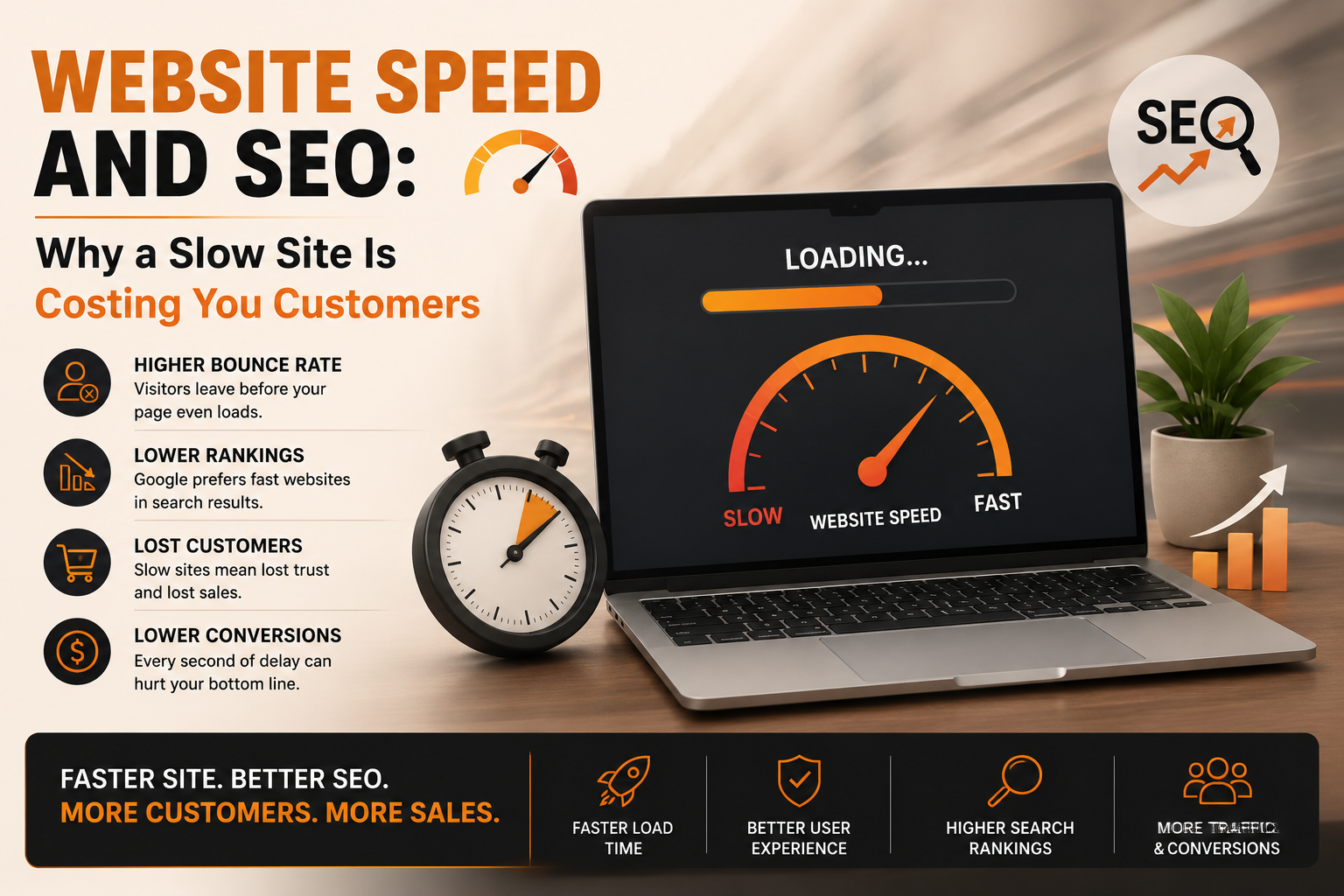
Imagine a visitor lands on your website, excited to check out what you offer — and then waits. And waits. Three seconds pass. They're gone, and they've probably clicked on a competitor instead. This isn't a rare scenario. Studies show that 53% of mobile users abandon a site that takes longer than 3 seconds to load. If you've been focused on design and content but ignoring load times, you could be losing customers before they ever see what you have to offer. In this guide, we'll break down website speed and SEO, why speed directly affects your Google rankings and your revenue, and exactly how to fix it.
What Is Website Speed and Why Does It Matter?
Website speed refers to how quickly your pages load and become usable for a visitor. It's measured through metrics like load time, Time to First Byte (TTFB), and Google's Core Web Vitals — Largest Contentful Paint (LCP), Interaction to Next Paint (INP), and Cumulative Layout Shift (CLS). Together, these numbers tell Google — and your visitors — how smooth your site experience really is.
Understanding website speed and SEO starts here: Google doesn't just want fast sites for the sake of speed. It wants sites that don't frustrate users, because frustrated users leave, and that signals a poor experience.
How Page Speed Affects SEO Ranking
Page speed has been a confirmed Google ranking factor for years, and it's become even more important with mobile-first indexing — meaning Google primarily uses the mobile version of your site to determine rankings. If you want to understand how page speed affects SEO ranking, think of it this way: Google's algorithm evaluates page experience signals alongside content relevance. A slow, clunky site can hold back even genuinely great content from ranking where it deserves to.
On top of direct ranking signals, speed influences indirect ones too — like bounce rate and dwell time — both of which Google interprets as quality signals over time.
The Real Cost: Website Loading Speed and Conversions
SEO ranking is only half the story. The bigger issue for most business owners is revenue. The connection between website loading speed and conversions is well documented — research has repeatedly shown that even a 1-second delay in load time can reduce conversions by up to 7%. For an e-commerce store or a service business generating leads, that's real money walking out the door.
Slow pages also increase cart abandonment, reduce average time on page, and lower the odds that a first-time visitor will trust your brand enough to convert. Speed isn't just a technical detail — it's part of your sales funnel.
Signs Your Slow Website Is Losing Customers
Not sure if speed is actually hurting your business? Watch for these signs of a slow website losing customers:
● High bounce rate, especially on mobile devices
● Low average time-on-page across key landing pages
● High cart abandonment rate on product or checkout pages
● Visitors reporting lag, freezing, or slow-loading images
● A noticeable drop in organic traffic despite fresh content
If two or more of these sound familiar, your site's speed is very likely costing you real customers — not just rankings.
How to Improve Website Speed for SEO
The good news: most speed issues are fixable without a full website rebuild. Here's exactly how to improve website speed for SEO, step by step.
Optimize Images
Large, uncompressed images are one of the most common causes of slow load times. Compress images before uploading and use modern formats like WebP instead of JPEG or PNG where possible.
Enable Browser Caching
Caching lets returning visitors load your site faster by storing certain files locally instead of re-downloading them on every visit.
Minimize CSS, JavaScript, and HTML
Removing unnecessary code, spaces, and comments (a process called minification) reduces file size and speeds up rendering.
Use a CDN (Content Delivery Network)
A CDN serves your website from servers closer to each visitor's location, cutting down load times significantly for a global or national audience.
Choose Reliable Hosting
Cheap, shared hosting is often the hidden culprit behind a sluggish site. Investing in quality hosting pays off in both speed and reliability.
Reduce Redirects and Plugins
Every redirect adds extra load time, and outdated or unnecessary plugins can silently slow your site down. Audit both regularly.
How to Test Your Website Speed
Before making changes, benchmark where you stand. Free tools like Google PageSpeed Insights, GTmetrix, and Pingdom will score your site and flag specific issues — from unoptimized images to render-blocking scripts — so you know exactly where to focus first.
How Yummy Marketings Can Help
At Yummy Marketings, we combine web development and SEO under one roof — so speed, design, and rankings are never treated as separate problems. Whether you need a full rebuild or a targeted speed audit, our team can identify exactly what's slowing your site down and fix it, so you stop losing customers to a page that just won't load fast enough.
Is your website losing customers to slow load times? Get a free speed and SEO audit from Yummy Marketings today.
Frequently Asked Questions
How much does website speed affect SEO ranking?
Speed is a confirmed Google ranking factor, especially for mobile search. While it's not the only factor, slow-loading sites often rank lower and see higher bounce rates, which indirectly hurts SEO further.
What is a good website loading speed?
Ideally, your site should load in under 2–3 seconds. Anything beyond 3 seconds significantly increases the chance of visitors leaving.
How can I check my website's speed for free?
Free tools like Google PageSpeed Insights, GTmetrix, and Pingdom let you test speed and get specific improvement suggestions.
Does mobile page speed matter more than desktop?
Yes — Google uses mobile-first indexing, meaning your mobile site speed is the primary factor in how Google ranks your site.
Can slow website speed really cause lost sales?
Yes. Studies show even a 1-second delay in load time can reduce conversions significantly, especially in e-commerce.


Comments