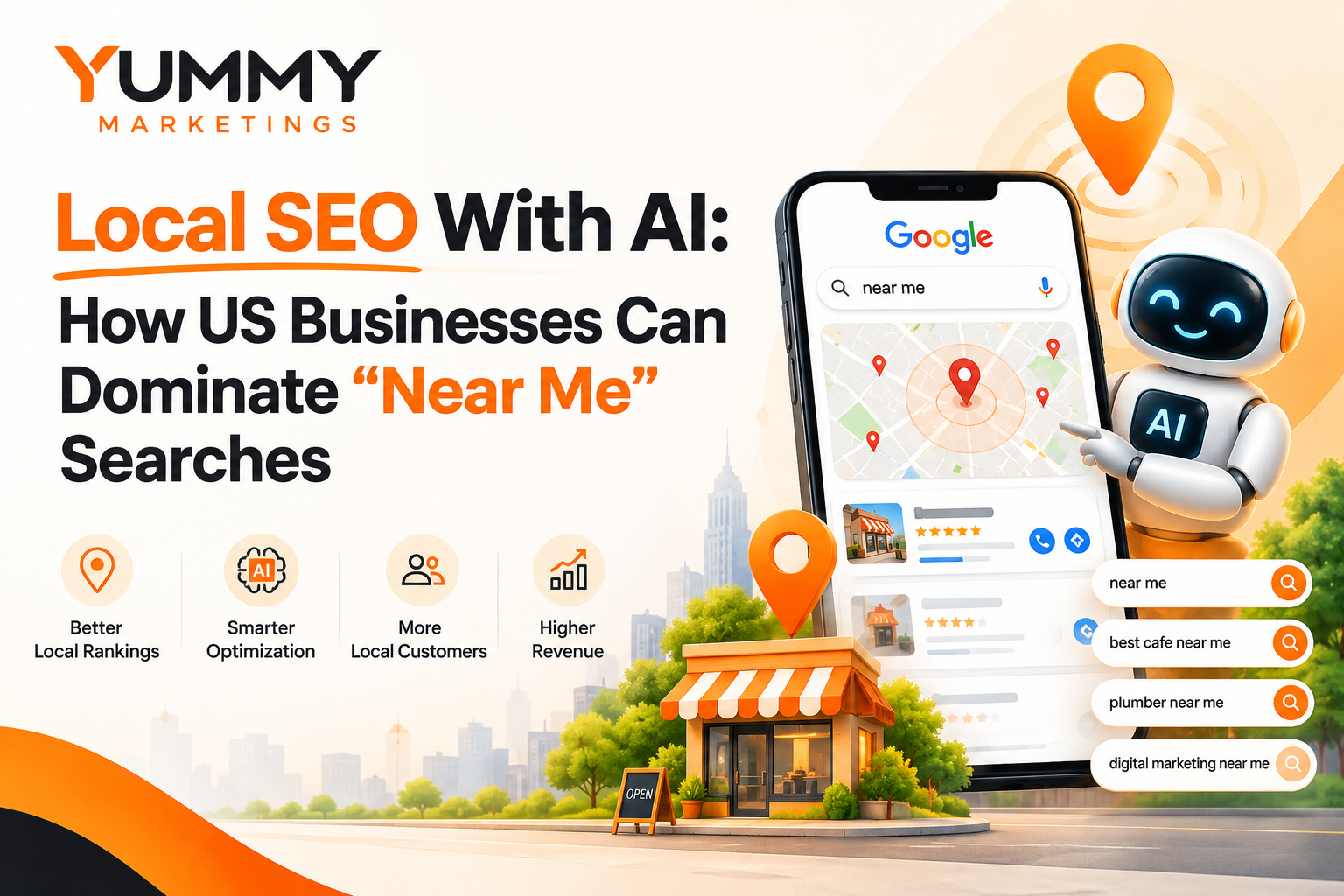
Picture someone standing on a street corner, phone in hand, typing "coffee shop near me" or "emergency plumber near me." They are not browsing. They want an answer now, and they will almost always pick one of the first few businesses Google shows. If your business is not in that group, you are invisible to the people most ready to buy.
That is the power of local SEO for small business. And in 2026, AI is changing how fast and how well you can compete for near me searches. In this guide, you will learn how near me rankings work, which basics you must get right first, how AI can speed up the work, and a step-by-step plan to rank higher in your area.
What Are "Near Me" Searches and Why They Matter
Near me searches are queries where the person wants a business, product, or service close to their current location. Google uses their location, even without the words "near me" in the query, to show nearby results.
What Counts as a Near Me Search
This includes direct phrases like "pizza near me," implied searches like "dentist in Austin," and voice searches like "where can I get my phone screen fixed." All of these trigger local results, usually a map with three highlighted businesses followed by regular listings.
Why Local Search Drives Calls, Visits, and Sales
Local searches are high intent. People searching for a nearby business are often ready to call, book, or visit within hours. That makes local SEO one of the most cost-effective channels for businesses with a physical location or a defined service area. [Add a verified, current statistic here from a credible source, such as Google or a recognized industry study.]
How Google Decides Who Shows Up
Google has said local results are based mainly on three factors:
- Relevance: how well your business matches what the person is searching for.
- Distance: how close your business is to the searcher or the location in the query.
- Prominence: how well known your business is, based on reviews, links, mentions, and overall web presence.
You cannot change where your business is located, but you can improve relevance and prominence, and that is where most of the opportunity sits.
Local SEO for Small Business: The Basics You Need First
AI can make local SEO faster, but it works best on top of a solid foundation. Get these fundamentals right before anything else.
Google Business Profile
Your Google Business Profile (GBP) is the single most important local ranking asset. Claim and verify it, choose the most accurate primary category, add your services, hours, photos, and a clear description, and keep it updated. Incomplete profiles lose to complete ones.
NAP Consistency
NAP stands for name, address, and phone number. These details should be identical on your website, your Google Business Profile, and every directory. Even small differences, like "Street" versus "St.", can create confusion and weaken trust signals.
Local Citations and Directory Listings
Citations are mentions of your business details on other sites, such as Yelp, Apple Maps, Bing Places, and industry directories. Accurate listings reinforce your legitimacy to search engines and help customers find you.
Location Pages and Service Area Pages
If you serve multiple cities, create a unique page for each one with genuine local details: neighborhoods served, local projects, and customer examples. Avoid copying the same text with only the city name swapped, as thin pages rarely perform.
Think of these basics as the foundation of a house. AI is the power tool that helps you build faster, but it cannot replace the foundation.
How AI Is Changing Local SEO
AI is affecting local search in two ways: how people search, and how businesses optimize.
AI Search and Local Results
Search is becoming more conversational. People ask longer questions by voice or chat, such as "Which dentist near me takes walk-ins on Saturday?" AI-powered search features can summarize local options, so clear, accurate, and detailed business information matters more than ever. Make sure your hours, services, and answers to common questions are easy to find and consistent across the web.
What AI Can Automate and What Still Needs a Human
AI is great for: drafting review replies, generating post ideas, researching local keywords, auditing listings, summarizing customer feedback, and producing first drafts of location content.
Humans are still essential for: local knowledge, genuine customer relationships, photos of your real business, accurate facts, and final review of anything that gets published. Real reviews and real experience cannot be faked, and generic AI content with no local detail tends to underperform.
Best AI Local SEO Tools for US Businesses
The right AI local SEO tools save hours every month. Below are common tool categories and examples. Tool features and pricing change often, so verify current details before choosing.
|
Tool Category |
What It Does |
Example Tools |
Best For |
|---|---|---|---|
|
Review management |
Collects reviews and drafts replies |
Birdeye, Podium, Google Business Profile |
Businesses with steady customer traffic |
|
Local rank tracking |
Tracks map pack and local rankings |
BrightLocal, Local Falcon |
Multi-location or competitive markets |
|
Keyword research |
Finds local search terms and questions |
Semrush, Ahrefs |
Content and page planning |
|
Citation audits |
Finds inconsistent or missing listings |
Whitespark, BrightLocal |
Cleaning up directory data |
|
AI writing assistants |
Drafts posts, FAQs, and page content |
Claude, ChatGPT |
Speeding up content creation |
AI Tools for Google Business Profile Posts and Updates
Use AI writing assistants to draft weekly posts about offers, events, and new services. Always add your own photos and local details before publishing.
AI Tools for Review Management and Replies
AI can draft thoughtful replies to reviews in seconds. Personalize each response and mention specifics from the review so it does not read like a template.
AI Tools for Local Keyword Research
Use AI and keyword tools together to find phrases like "emergency plumber in [neighborhood]" or "best family dentist near [landmark]." Look for specific, low-competition local terms.
AI Tools for Local Content Creation
AI can create outlines for city pages, neighborhood guides, and FAQ content. Add real examples, local references, and customer stories so the content is genuinely useful and unique.
AI Tools for Citation and Listing Audits
Audit tools scan directories for inconsistent business details and duplicates. AI can help prioritize which fixes matter most.
Step-by-Step: How to Rank Higher in Near Me Searches With AI
Here is a practical plan you can start this week.
Step 1: Claim and Fully Optimize Your Google Business Profile
Verify your profile, select the right categories, list all services and products, add high-quality photos, and write a clear description. Turn on messaging or booking features if they fit your business. Review your profile monthly.
Step 2: Find Local Keywords With AI
Ask an AI assistant to brainstorm how customers in your area describe your service, then confirm search volume in a keyword tool. Group the terms by service and location to guide your pages and posts.
Step 3: Build Location-Specific Pages and Content
Create service pages for each main offering and location pages for each area you serve. Include local details, real photos, customer testimonials, and a clear call to action. Use AI for the first draft, then edit for accuracy and local flavor.
Step 4: Collect and Respond to Reviews at Scale
Reviews are a major prominence signal. Ask every happy customer for a review through a text or email with a direct link. Respond to all reviews, positive and negative, within a day or two. Never buy or fake reviews, because that can get your listing suspended.
Step 5: Fix Citations and Local Listings
Use an audit tool to find mismatched or duplicate listings, then correct them. Prioritize the major platforms first: Google, Apple Maps, Bing, Yelp, Facebook, and your industry directories.
Step 6: Track Local Rankings and Map Pack Performance
Monitor your position in the local map pack for your main keywords, along with calls, direction requests, and website clicks from your Google Business Profile. Use that data to decide what to improve next.
Local SEO Strategies by Industry
Every industry has its own local search patterns. Here is one tactic to start with for each.
Restaurants and Cafes
Keep your hours, menu, and photos current, and post specials regularly. Encourage diners to mention dishes in their reviews, since this helps you appear for specific food searches.
Home Services (Plumbers, Electricians, HVAC)
Create a separate page for each service and each city you serve. Add before-and-after photos and respond fast to reviews, because trust is the deciding factor for emergency searches.
Healthcare and Dental Practices
List every provider, accepted insurance plans, and services clearly. Keep information accurate and compliant, and use FAQ content to answer patient questions.
Law Firms and Professional Services
Build practice-area pages tied to specific cities, and publish helpful local guides. Reviews and professional directory listings carry extra weight in these fields.
Common Local SEO Mistakes to Avoid
- Inconsistent business information across directories and your website.
- Keyword stuffing your business name in Google Business Profile, which violates Google's guidelines and risks suspension.
- Publishing generic AI content with no local detail, which adds little value for readers or search engines.
- Ignoring negative reviews. A thoughtful response shows prospective customers you care.
- Using fake reviews or fake addresses. This can lead to penalties or removal from search results.
How Long Does Local SEO Take to Work?
Most businesses see early improvements in map pack visibility within 1 to 3 months, with stronger and more stable results over 3 to 6 months. Timing depends on your competition, your location, and where you are starting from. A new business in a crowded city will take longer than an established business in a smaller market. Consistency matters more than quick fixes.
How Yummy Marketing Helps With Local SEO
At Yummy Marketing, we combine AI-powered efficiency with experienced human strategists to help US businesses show up where local customers are searching. From Google Business Profile optimization and review strategy to local content and citation cleanup, we build plans around your market and goals.
[Add a real client result here: the industry, the starting point, what was done, and verified outcomes such as increases in map pack visibility, calls, or direction requests.]
Want to see where you stand in local search? Get a free local SEO audit from Yummy Marketing.
Frequently Asked Questions
What is local SEO and how does it work?
Local SEO is the process of improving your visibility in location-based searches. It works by optimizing your Google Business Profile, website, reviews, and listings so search engines see your business as relevant, nearby, and trustworthy for local customers.
How do I rank higher in near me searches?
Start with a fully optimized Google Business Profile, consistent business details across the web, strong reviews, and location-focused website content. Then keep your profile active with posts and photos, and track your map pack rankings over time.
Is local SEO worth it for small businesses?
For most businesses with a physical location or service area, yes. Local searchers are often ready to act, and local SEO can deliver calls and visits at a lower cost than many paid channels, especially over the long term.
Can AI really improve local SEO?
Yes, as a tool for speed and scale. AI helps with research, content drafts, review replies, and audits. But results still depend on accurate information, real reviews, and human review of everything AI produces.
How much does local SEO cost in the US?
Costs vary by market and scope. Many small businesses invest roughly $500 to $2,500 per month for ongoing local SEO, while multi-location businesses pay more. Always confirm exactly what is included before signing.
How do I get into the Google local map pack?
Optimize your Google Business Profile, choose accurate categories, earn consistent reviews, keep your NAP details consistent, and build local relevance on your website. Proximity also plays a role, so results vary by searcher location.
Do online reviews affect local rankings?
Yes. The quantity, quality, and recency of reviews, along with how you respond, influence both rankings and customer trust. Always earn reviews honestly, since fake reviews can lead to penalties.
Final Thoughts: Turn Near Me Searches Into Customers
Dominating near me searches comes down to getting the basics right, staying consistent, and using AI to work faster without losing the human touch. Start with your Google Business Profile, build trust through reviews, and create genuinely local content.
Ready to rank higher in your area? Book a free consultation with Yummy Marketing and we will build a local SEO plan that fits your business.


Comments