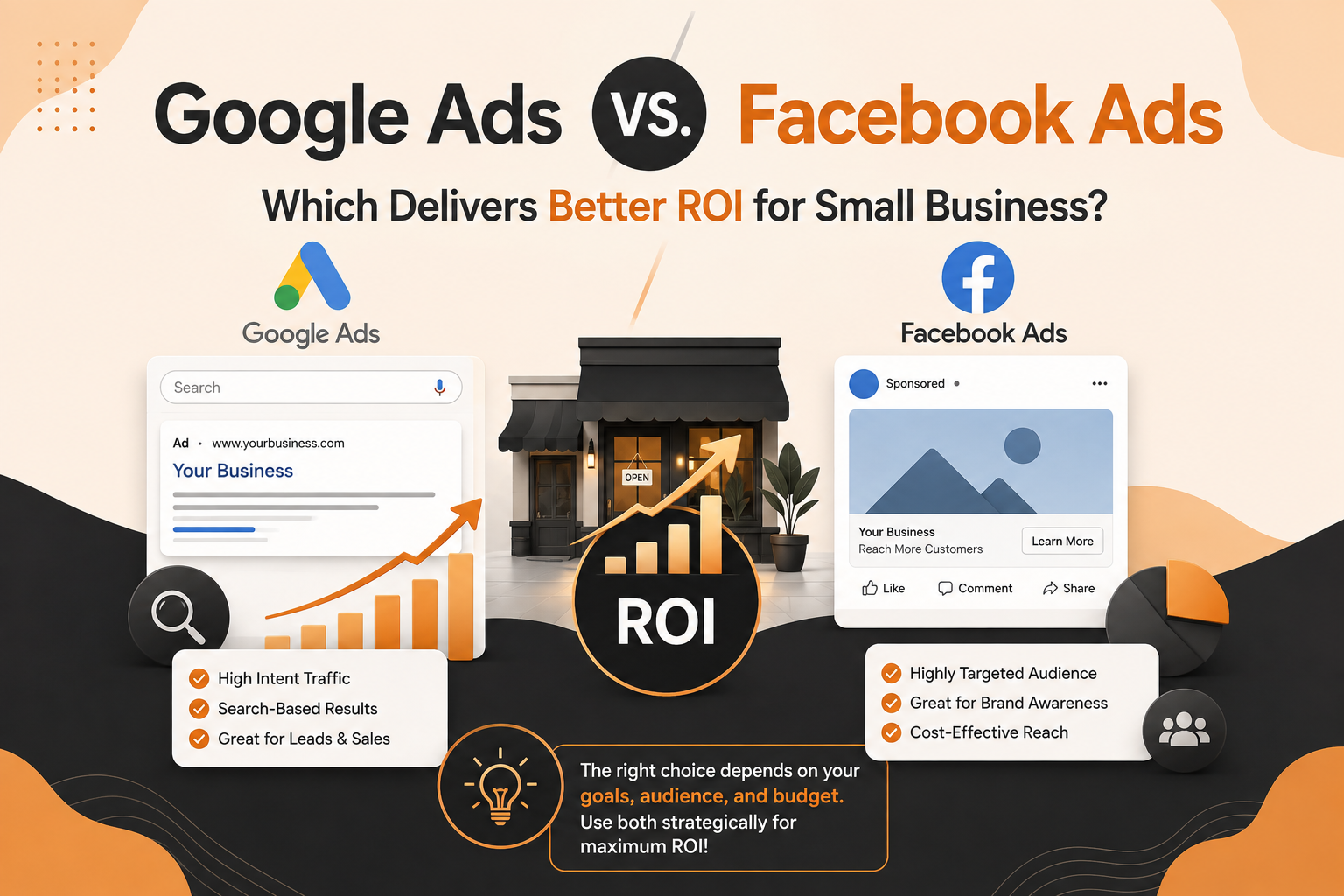
If you run a small business, you've probably faced this exact question: should you put your marketing budget into Google Ads or Facebook Ads? Both platforms promise results, both can eat your budget fast if used wrong, and both work very differently under the hood.
The truth is, Google Ads vs Facebook Ads isn't really an either-or decision for most businesses — it's about understanding what each platform does best, what it costs, and which one matches your goals right now. In this guide, we'll break down the real cost differences, conversion rates, targeting options, and best use cases so you can decide where your next ad dollar should go.
Google Ads vs. Facebook Ads: The Key Differences
The biggest difference between these two platforms comes down to intent.
Search Intent vs. Social Discovery
Google Ads shows up when someone is actively searching for a product, service, or answer. They already have a need — you're just showing up at the right moment. This is called "high intent" traffic.
Facebook Ads work differently. People aren't searching for anything; they're scrolling through their feed. Your ad has to interrupt them and create interest in something they weren't necessarily looking for. This is often called "discovery" or "interruption" marketing.
Neither approach is better in general — they simply serve different stages of the buyer's journey.
How Each Platform Targets Customers
Google Ads targets based on keywords and search behavior — what people type into the search bar, their location, device, and past browsing behavior tied to intent.
Facebook Ads targets based on demographics and interests — age, location, job title, interests, behaviors, and lookalike audiences built from your existing customers. This makes Facebook especially strong for building brand awareness with a very specific audience profile, even if that audience isn't actively searching yet.
| Factor | Google Ads | Facebook Ads |
|---|---|---|
| Targeting basis | Keywords, search intent | Demographics, interests, behavior |
| Best for | Bottom-of-funnel, ready-to-buy customers | Top-of-funnel awareness, retargeting |
| Ad format | Text, Shopping, Display | Image, video, carousel, Stories |
Google Ads vs. Facebook Ads Cost Comparison
Cost is usually the first question business owners ask, and it depends heavily on your industry.
Average Cost Per Click (CPC) for Google Ads
Google Ads CPCs vary widely by industry and competition. Legal, insurance, and finance keywords can run $10-$50+ per click, while less competitive niches might see $1-$3 per click. Because you're targeting people already searching, the trade-off is usually a higher CPC but a shorter path to conversion.
Average Cost Per Click (CPC) for Facebook Ads
Facebook Ads generally have a lower average CPC, often in the $0.50-$3 range depending on audience and industry. However, since users aren't actively searching, it can take more impressions and a longer nurture sequence before someone converts.
Which Platform Costs Less for Small Businesses?
On a per-click basis, Facebook Ads are usually cheaper. But cost-per-click isn't the same as cost-per-customer. A $1 Facebook click that never converts is more expensive in the long run than a $5 Google click that turns into a sale. This is why looking at cost per acquisition (CPA) and return on ad spend (ROAS) matters more than CPC alone.
Facebook Ads vs. Google Ads Conversion Rate
Conversion Rates by Industry
Conversion rates vary by industry on both platforms, but Google Ads search campaigns often report average conversion rates in the 3-8% range across many industries, since traffic is already primed with intent. Facebook Ads conversion rates tend to run lower on cold traffic but improve significantly with retargeting campaigns aimed at people who've already engaged with your brand.
Why Intent-Based Traffic Often Converts Higher
Someone searching "emergency plumber near me" is ready to act now. Someone scrolling Facebook who sees a plumbing ad may not need a plumber for months. That's not a flaw in Facebook Ads — it just means the platform is better suited for building a pipeline of future customers rather than closing immediate sales.
Which Is Better for Lead Generation: Google Ads or Facebook Ads?
B2B vs. B2C Lead Gen Differences
For B2B businesses, Google Ads often performs better for bottom-funnel lead capture (someone searching "CRM software for small teams"), while Facebook/LinkedIn-style targeting works well for earlier-stage awareness and nurturing.
For B2C businesses, especially those with visually appealing products or emotionally driven purchases (fashion, home goods, food, fitness), Facebook Ads often outperforms because of the image/video-first format.
Best Use Cases for Each Platform
- Choose Google Ads if: customers actively search for what you offer, you have a clear service area, or you're in an industry with defined "buying keywords."
- Choose Facebook Ads if: your product is visually appealing, you're building brand awareness, or you want to retarget past website visitors.
Google Ads vs. Facebook Ads for Local Business
Local Service Ads vs. Location-Based Facebook Targeting
Google's Local Service Ads and location-targeted search campaigns are built for "near me" searches — ideal for home services, healthcare, restaurants, and local retail. Facebook, meanwhile, lets you target a radius around your business with demographic and interest layers, which works well for local awareness campaigns, events, or promotions.
Best Platform for "Near Me" Searches
For "near me" and urgent local searches, Google Ads generally wins because it captures people at the exact moment of need.
Google Ads or Facebook Ads for E-commerce?
Shopping Ads vs. Facebook Shop Ads
Google Shopping Ads display your product, price, and store directly in search results — great for capturing people who already know what they want to buy. Facebook Shop Ads work well for product discovery, especially with strong visuals and social proof.
Retargeting Capabilities Compared
Both platforms offer strong retargeting, but Facebook's ad formats (carousel, dynamic product ads) are often considered more effective for re-engaging cart abandoners with visually rich reminders.
Pros and Cons Summary Table
| Platform | Pros | Cons | Best For |
|---|---|---|---|
| Google Ads | High intent traffic, faster conversions, strong for local | Higher CPC in competitive industries | Bottom-of-funnel, urgent needs, local services |
| Facebook Ads | Lower CPC, strong visuals, great targeting options | Lower intent, longer conversion path | Brand awareness, retargeting, visually-driven products |
How to Decide Which Platform Is Right for Your Business
Questions to Ask Before Choosing
- Do people actively search for what I sell, or do I need to create demand?
- Is my product highly visual or benefit-driven through storytelling?
- What's my sales cycle — instant purchase or longer consideration?
- What's my available budget, and can I test both platforms simultaneously?
Why Many Businesses Use Both (and How to Split Budget)
Many successful small businesses don't choose one over the other — they use Google Ads to capture high-intent demand and Facebook Ads to build awareness and retarget past visitors. A common starting split is 60/40 or 70/30 favoring whichever platform matches your primary sales motion, then adjusting based on performance data after 30-60 days.
Real Case Study / Example ROAS Comparison
(Add a real or anonymized client example here — for instance: "A local HVAC client shifted 70% of their budget to Google Local Service Ads and saw a 3.2x ROAS within 60 days, compared to 1.8x ROAS on Facebook awareness campaigns during the same period." Replace with your agency's actual results for credibility and trust.)
Final Verdict: Which Platform Wins for ROI?
There's no universal winner — it depends on your business model, sales cycle, and goals. Google Ads tends to deliver faster, higher-intent conversions, making it ideal for local and service-based businesses. Facebook Ads tends to deliver more affordable reach and stronger brand-building, making it ideal for e-commerce and visually driven products.
The businesses that win aren't the ones that pick a side — they're the ones that test both platforms, track real ROAS (not just CPC), and reallocate budget based on data.
Not sure which platform is right for your business? [Agency Name] builds data-driven ad strategies across Google and Facebook so you're not guessing where your budget goes. [Get a free ad strategy consultation →]
FAQs
Is Google Ads better than Facebook Ads for small business? It depends on your business type. Google Ads tends to work better for businesses with clear search demand (like local services), while Facebook Ads tends to work better for visually driven or awareness-focused brands.
Which is cheaper, Google Ads or Facebook Ads? Facebook Ads usually have a lower cost per click, often under $3, while Google Ads CPCs can range from $1 to $50+ depending on industry competition. However, lower CPC doesn't always mean lower cost per customer.
Can I use Google Ads and Facebook Ads together? Yes. Many businesses use Google Ads to capture high-intent searchers and Facebook Ads to build awareness and retarget past website visitors, creating a full-funnel strategy.
What has a higher ROI, Google Ads or Facebook Ads? It depends on the funnel stage. Google Ads often delivers faster ROI on bottom-funnel, ready-to-buy traffic, while Facebook Ads can deliver strong long-term ROI through brand building and retargeting.
Which platform is better for lead generation? Google Ads generally performs better for direct lead capture in industries with clear "buying keywords," while Facebook Ads performs well for earlier-stage lead nurturing and awareness campaigns.
Comments